Condo Bathroom Tile Boston: Costs, HOA Rules & Best Materials
The cost of condo bathroom tile in Boston runs from $700 to $11,500+, depending on scope. That covers re-grouting, floor replacement, tub surrounds, and full shower rebuilds. Boston condos add complexity that single-family homes don't face: HOA approvals, elevator logistics, restricted work hours, and debris removal without a street dumpster. These factors affect both cost and schedule for every condo bathroom tile project in the city.
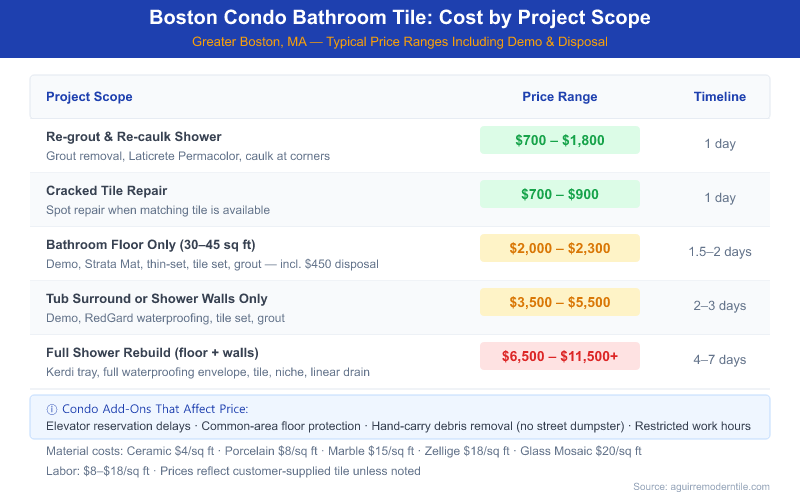
- Cost range: $700 for a re-grout to $11,500+ for a floor-plus-shower combo (labor and setting materials included; tile not included)
- Condo board requirements: Most Boston associations require a certificate of insurance, set specific work hours, and may require elevator reservation or neighbor notification before demo begins
- Waterproofing: Shower walls get RedGard liquid membrane; shower floors use a Schluter Kerdi tray with integrated drain — we make the drain connection ourselves
- Floor substrate: Schluter Strata Mat uncoupling membrane provides crack isolation and acoustic control for units below
- Tile is customer-supplied: You buy the tile; we help you pick it and install it
- Timeline: Most Boston condo bathroom tile jobs run 2 to 5 working days on-site
Need a price for your condo bathroom tile project in Boston? Send us photos through our estimate form — we return a written quote broken out by scope. No commitment required.
Back to Bathroom Tile Installation Cost in Boston — for the full cost breakdown across all bathroom types in Greater Boston.
How Much Does Condo Bathroom Tile Installation Cost in Boston?
Condo bathroom tile in Boston costs $700 to $11,500+, depending on what's being replaced. The tile costs the same as in a single-family home. The difference is logistics: elevator use, hallway protection, and stricter debris removal add overhead. Based on estimates we've written across Boston, South Boston, the South End, and Charlestown, here are current 2026 ranges:
Scope | Price Range | Notes |
|---|---|---|
Re-grout and re-caulk shower | $700 – $1,800 | Depends on shower size and old grout volume |
Cracked tile repair | $700 – $900 | Only when matching tile is available |
Bathroom floor, 30–45 sq ft (demo included) | $2,000 – $2,300 | Customer-supplied tile; includes $450 disposal fee |
Kitchen backsplash, 17–35 sq ft | $1,100 – $2,500 | Includes removing old backsplash |
Tile-only shower (homeowner-prepped walls and pan) | $3,300 – $3,800 | Homeowner or GC handles waterproofing |
Tub surround tear-out and retile, 60–80 sq ft | $4,300 – $5,000 | Add $400 for a recessed niche |
Shower floor replacement (Kerdi tray, walls stay) | $4,100 – $4,500 | Common fix for leaking condo shower floors |
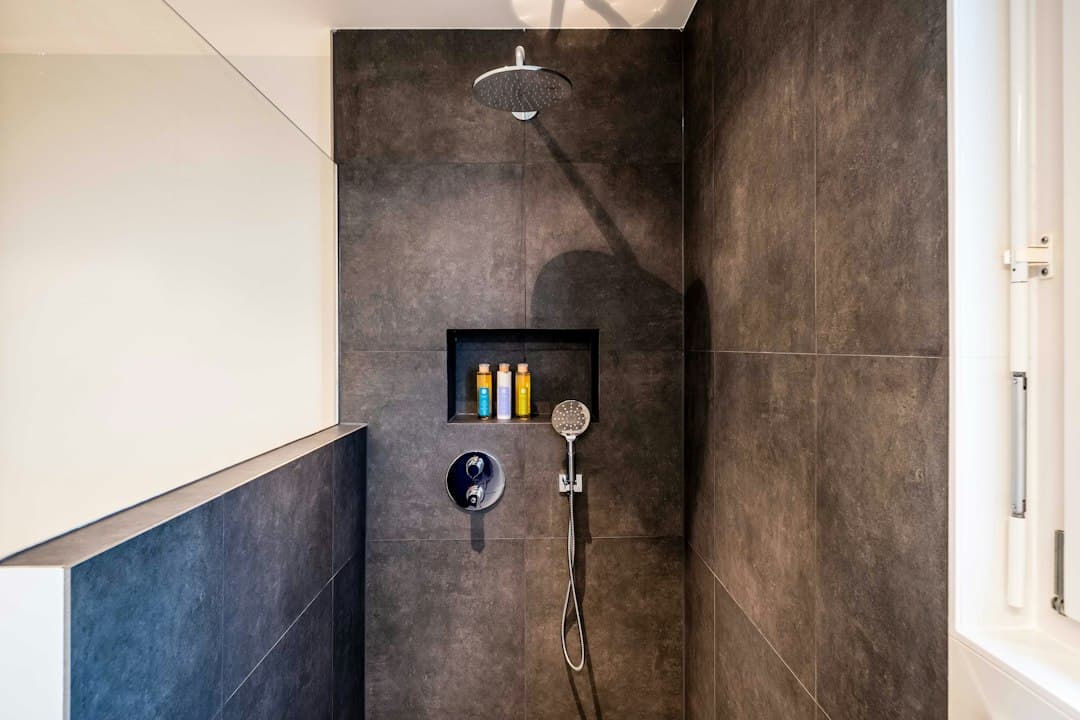
Full shower tear-out and rebuild | $5,000 – $7,000+ | Benches, stone sills, and larger showers push it higher |
Bathroom floor plus shower, combined | $7,500 – $11,500 | Heated floor option sits at the top of this range |
All prices include labor, setting materials — thin-set, Laticrete Permacolor grout, waterproofing membrane — and a $450 tile disposal fee where demo is involved (based on current Greater Boston rates, as of 2026 pricing). Tile is not included.
The $450 disposal fee adds up fast in condos. Most Boston buildings prohibit roll-off dumpsters. Old tile, cement board, and mortar go out by hand through the elevator and into a work truck. That labor is built into every job price.
What Are the Condo-Specific Challenges for Bathroom Tile in Boston?
Boston condos require more planning than single-family homes. Access rules, HOA requirements, and insurance obligations affect every condo bathroom tile job — from brownstones in Back Bay and the South End to towers in the Seaport and triple-deckers in South Boston.
HOA and Condo Board Requirements
Most condo associations require a certificate of insurance (COI) before any contractor enters the unit. We carry full liability insurance and send a COI to your building management on request — no extra cost, but allow a few days of lead time. Common requirements beyond insurance include:
- Work hours limited to weekday business hours (often 8 AM – 5 PM or tighter)
- Elevator reservation with floor protection during material moves
- Written notice to neighbors before demolition begins
- Restrictions on debris staging in common areas
- Wet work notifications where a leak could affect the unit below
Building Access and Logistics
Moving materials through a condo building takes longer than a house. Elevator scheduling, hallway protection, and staged debris removal all add time. Across 500+ completed Boston-area projects, condo bathroom tile jobs consistently run about a half-day longer than the same scope in a single-family home.
Condo Logistics Factor | How It Affects the Job |
|---|---|
Elevator reservation | May limit material delivery to one window per day; requires building management coordination |
Common-area floor protection | Required in most buildings; crew installs and removes it each day |
No street dumpster | Debris goes out by hand — adds time per load of tile and mortar |
Work hour restrictions | Typically 8 AM – 5 PM; shorter productive window than a house job |
COI required | We send it on request at no extra charge; needs a few days of lead time |
Noise and neighbor management | Demo is the loudest phase; schedule with your association in advance |
Which Tile Materials Work Best for Boston Condo Bathrooms?
Porcelain is the most common choice for Boston condo bathrooms. It handles moisture well and works on every wet surface. Here's how the main tile types compare for condo-specific conditions:
Tile Type | Example Brands | Best Surfaces | Key Condo Consideration |
|---|---|---|---|
Porcelain (12x24 or 12x12) | Daltile, MSI, Emser | Floors, shower walls, tub surrounds | Low water absorption; handles humidity swings and older plumbing well |
Ceramic | American Olean, Marazzi | Shower walls, tub surrounds, backsplash | Lighter than porcelain; easier to cut in tight condo bathrooms |
Natural stone (marble, travertine, limestone) | Anatolia Marmiline, MSI Calacatta Gold | Feature walls, curb sills, shower floors | Requires sealing; heavier than porcelain — verify subfloor load in older buildings |
Subway tile (3x6, 4x16, 3x9) | Daltile Restore, American Olean Urbanity | Tub surrounds, shower walls, backsplash | Corner joints need caulk (not grout) to handle building movement |
Hex mosaic (1-inch or 2-inch) | MSI Penny Round, Daltile Keystones | Shower floors, bathroom floors, accents | More grout lines; Laticrete Permacolor holds up well in continuously wet areas |
Large format (24x24 or 24x48 porcelain) | MSI Montage Plus, Emser Perspective | Bathroom floors, feature shower walls | Needs a very flat substrate; condo floors sometimes need self-leveling compound first |
Natural stone and large-format porcelain are significantly heavier than standard ceramic or porcelain tiles. In a third-floor brownstone with aging floor framing, that matters. We check flatness and substrate condition before recommending any heavy-format tile. For a full breakdown of tile selection by surface and substrate, see the Tile Installation for Bathroom: The Complete How-To Guide.
What Waterproofing and Underlayment Do Boston Condos Require Under Tile?
Waterproofing a condo bathroom shower is not optional. A leak that reaches the unit below is a liability issue. Every shower we tile gets a complete, tested system — consistent with TCNA (Tile Council of North America) installation guidelines for multi-unit residential buildings.
Surface | System We Use | Why It Matters in a Condo |
|---|---|---|
Shower walls | RedGard liquid membrane (Custom Building Products), two brush-applied coats over cement board | Contains moisture before it reaches the building structure or the unit below |
Shower floor | Schluter Kerdi tray + Kerdi drain (we make the drain connection ourselves) | Fully bonded system; no mortar bed to crack; no plumber needed unless the drain moves |
Shower pan-to-wall joint | Schluter Kerdi-Band fabric tape | Seals the transition between floor and wall waterproofing — a common leak point |
Bathroom floor | Schluter Strata Mat uncoupling membrane | Decouples tile from subfloor movement; achieves IIC 64 / STC 53 per Schluter technical specifications |
Heated bathroom floor | Single Nuheat or Schluter Ditra-Heat cable (replaces Strata Mat) | One cable sized to open floor area; Ditra-Heat combines heat and uncoupling in one layer |
The Strata Mat acoustic data matters for Boston condo owners. Many associations set minimum IIC or STC ratings for new hard flooring. Per Schluter's published technical specifications, Strata Mat achieves an IIC rating of 64 and STC of 53. That meets or exceeds most Boston condo association requirements. Check your building's rules before choosing an underlayment system.
On shower floors, we set tile in Laticrete 254 Platinum thin-set bonded directly to the Kerdi tray surface. On bathroom floors, Strata Mat goes down first with 254 Platinum. Then the tile sets over it with polymer-modified mortar. Both systems hold up in buildings where subfloors move seasonally — which describes most Boston condos built before 2000.
How Long Does a Condo Bathroom Tile Project Take in Boston?
Most condo bathroom tile jobs take 2 to 5 working days on-site. Condo logistics add roughly a half-day to most projects. Here's what to expect by scope, based on our current 2026 scheduling across Boston jobs:
Project Type | Typical On-Site Days | Primary Time Drivers |
|---|---|---|
Re-grout and re-caulk shower | 1 day | Grout removal, Laticrete Permacolor application, caulk at corners |
Bathroom floor only (30–45 sq ft) | 1.5 – 2 days | Demo, Strata Mat, thin-set, tile set, grout cure |
Tub surround or shower walls only | 2 – 3 days | Demo, RedGard waterproofing, tile set, grout |
Full shower tear-out and rebuild | 3 – 5 days | Demo, Kerdi tray, RedGard, tile set, grout, stone sill install |
Floor plus shower combined | 4 – 6 days | Full scope; condo access adds roughly half a day versus a house |
A deposit holds your start date. The balance is due when the job is done. We quote per area, so you can book the shower now and schedule the floor later. Same crew — no need to re-quote from scratch.
What Boston Condo Bathroom Tile Designs Are Popular Right Now?
Boston condo bathroom tile design varies by neighborhood and building era. In our 15+ years of experience as a tile contractor in Boston, here's what we're installing most often in 2026:
Neighborhood | Building Style | Popular Tile Format | Dominant Aesthetic |
|---|---|---|---|
Back Bay | Historic brownstone | 24x24 marble-look porcelain floors, 3x12 subway walls | Transitional classic — warm whites, soft greiges |
South End | Victorian row house condo | 4x16 subway walls, Anatolia Marmiline stone sills and curbs | Classic base with natural stone accents |
Seaport / Fort Point | New construction tower | 24x48 or 48x48 large-format rectified porcelain | Modern minimalist — matte finishes, near-zero grout lines |
South Boston | Triple-decker conversion and mid-rise | 12x24 porcelain in brick pattern on walls, 2x2 mosaic on shower floor | Clean and durable — easy to source, holds up to heavy use |
Charlestown | Converted historic mill and mid-rise | 3x9 or 4x16 subway walls, penny round or hex mosaic floors | Traditional materials paired with modern fixture finishes |
A few patterns appear across all Boston neighborhoods right now. Herringbone layout — subway tile on shower walls or hex mosaic on bathroom floors — adds visual interest with no material cost premium. Stacked vertical subway tile (3x12 set vertically) makes low ceilings in compact condo bathrooms feel taller. Mixed-format installs — large-format porcelain on the floor with small mosaic in the shower pan — cleanly separate wet and dry zones while keeping the palette cohesive.
For a full shower rebuild, a single row of decorative accent tile or contrasting Laticrete Permacolor grout mid-wall adds character without changing the tile budget. It's a detail we add frequently on South End and Back Bay jobs.
How to Choose a Tile Installer for Your Boston Condo Bathroom
Hiring a tile installer for a condo job means verifying a few things a house job doesn't require. Run through this list before signing anything:
- Certificate of insurance — your building requires it; a serious contractor sends it without extra fees
- Multi-unit building experience — ask specifically about condo jobs; elevator logistics and work-hour compliance matter
- Per-area estimates — a good quote breaks each scope (floor, shower, tub surround) into separate line items so you can phase the work
- Named waterproofing system — ask exactly what they use; RedGard on walls and a Schluter Kerdi tray on the shower floor is the right answer
- Debris disposal plan — confirm who handles demo material and how it exits the building
- Photo-based quoting — a capable installer can quote from photos first; a site visit follows for complex scopes
Aguirre Modern Tile has installed condo bathroom tile across Boston, South Boston, the South End, and Charlestown for 15+ years. We carry full liability insurance and send COIs to building management on request. Every estimate is broken out by area — shower, floor, and tub surround priced separately — so you see the cost of each scope before committing. Our two-person crews know condo logistics: elevator schedules, common-area floor protection, and debris removal without a dumpster.
For a complete walk-through of the installation process, the Complete Guide to Bathroom Tile Installation covers every step from substrate prep through final grout.
Send us photos of your condo bathrooms and we'll write up a quote broken out by area.
Frequently Asked Questions
Does my Boston condo association need to approve bathroom tile work?▾
What waterproofing system is best for a Boston condo shower?▾
How do contractors remove tile debris from a condo building?▾
Does Schluter Strata Mat meet condo association soundproofing requirements?▾
Can I tile just the shower now and do the floor later in my condo?▾
Need Bathroom Tile Installation?
Send us photos and get a same-day estimate.