Bathroom Floor Tile Installation: The Pro Process, Step by Step
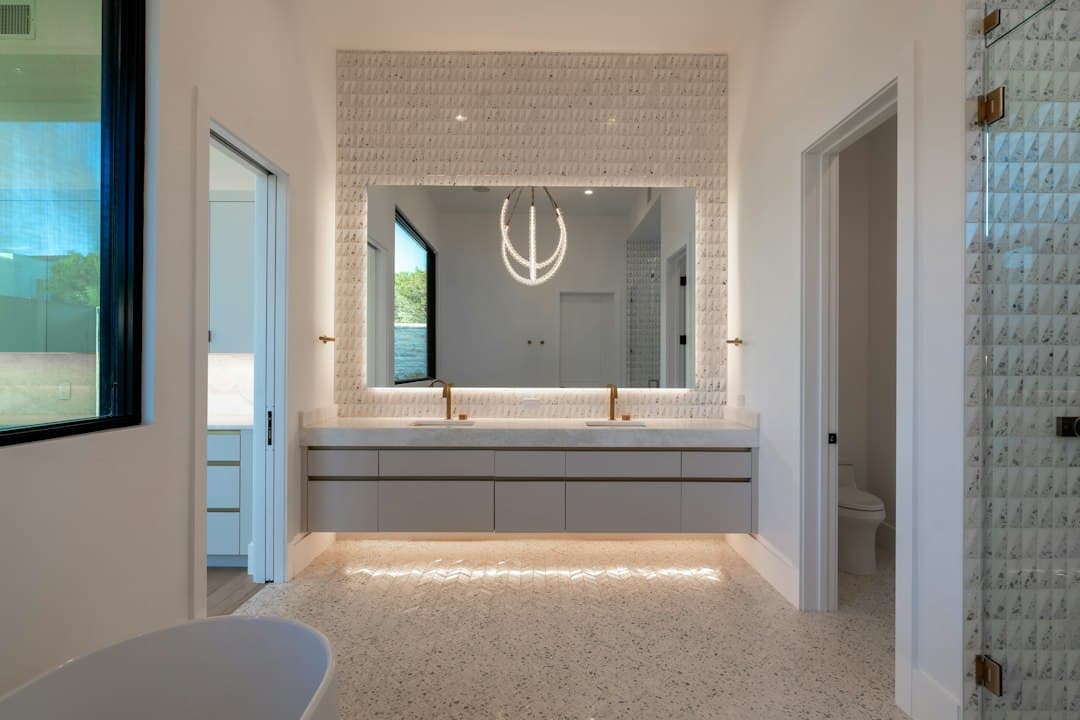
Bathroom floor tile installation is the job of removing the old floor, making the subfloor flat and stiff, and setting tile over an uncoupling membrane so it does not crack. A professional crew pulls the toilet, preps the subfloor, lays the membrane, sets and grouts the tile, then resets the toilet. In Greater Boston, floor tile runs about $10 to $30 per square foot installed (as of 2026 pricing). Most bathroom floors land at the short end of the 2 to 7 day range for floor work. This page is part of our Bathroom Tile Installation Complete Guide.
Key Takeaways
- The prep is the job. A flat, stiff subfloor and an uncoupling mat keep floor tile from cracking.
- The toilet comes out. We tile under it, never around it, then reset it on a new seal.
- Our floor build: Laticrete STRATA_MAT set in 254 Platinum, with tile set in 253 Gold over the mat.
- Heated floors use one cable sized to the open floor, and it replaces the uncoupling mat.
- Cost: $10 to $30 per square foot installed, with labor at $7 to $18 per square foot (based on current Greater Boston rates).
Thinking about porcelain or a heated floor for your bathroom? Send us photos of your bathroom floor for a same-day estimate. A wide shot of the room and a close-up of the floor around the toilet are enough to start.
How Does a Pro Install Bathroom Floor Tile, Step by Step?
A pro installs bathroom floor tile in nine steps, and most of them happen before any tile goes down. Each step fixes a problem that would otherwise show up as a cracked tile or a loose grout line.
- Protect and demo. We cover the tub and hallway, pull the toilet and remove the old tile or vinyl down to the subfloor.
- Check the subfloor. We look for rot near the toilet and tub, soft spots and loose boards. Older Boston homes often have uneven wood subfloors that need work.
- Repair and stiffen. We replace rotted sections and screw down loose plywood. A bouncy floor gets fixed before anything else.
- Uncoupling mat. We bond STRATA_MAT to the subfloor with 254 Platinum thin-set.
- Dry layout. We lay out tile without mortar to center the pattern on the doorway and the main sightline. Small cuts go under the vanity or along the tub, not at the door.
- Set the tile. We set tile in 253 Gold over the mat. Large tiles get back-buttered and held flush with leveling clips such as Raimondi or Spin Doctors.
- Grout. We grout with Laticrete Permacolor in the color you pick.
- Trim the doorway. A metal transition strip finished to match the grout meets the hallway floor.
- Reset and seal. We reset the toilet and run flexible sealant where the floor meets the tub.
Can You Tile Over an Existing Bathroom Floor?
We do not tile over old tile. Going over it raises the floor, can leave the toilet flange too low, and hides any rot or loose tile underneath. The old floor comes up so we can see and fix the subfloor. Demo is part of our standard floor scope.
How Do You Install Tile Around a Toilet?
You install tile around a toilet by taking the toilet out and tiling the whole floor under it. Cutting tile around the base looks sloppy and leaves a weak joint where water collects. Pulling and resetting the toilet is part of our floor job.
- Shut off the water, drain the tank and bowl, and disconnect the supply line.
- Remove the toilet and plug the drain opening so tools and sewer gas stay where they belong.
- Check the subfloor around the flange for rot. Soft wood here is common after years of small leaks.
- Tile right up to the flange with clean, tight cuts.
- Check the flange height. If the new floor sits higher than the flange, we add a flange extender so the toilet seals properly.
- Reset the toilet on a new wax ring or wax-free seal, then reconnect and test for leaks.
If you want the toilet moved to a new spot, that is a plumber's job. We work around their schedule and tile once the new drain is set.
Which Uncoupling Membrane and Thinset Go Under Bathroom Floor Tile?
Our bathroom floors go down over Laticrete STRATA_MAT, an uncoupling membrane. We bond the mat to the subfloor with Laticrete 254 Platinum and set the tile on top with Laticrete 253 Gold. Each mortar does the job it is best at.
What Is an Uncoupling Membrane?
An uncoupling membrane is a thin plastic mat that sits between the subfloor and the tile. It lets the wood subfloor move a little with the seasons without cracking the tile above it. Boston's humidity swings between summer and winter make that movement real. Schluter DITRA is the best-known version, at 1/8 inch thick.
Product | Role | Where it goes |
|---|---|---|
Laticrete STRATA_MAT | Uncoupling membrane | Over the plywood subfloor |
Laticrete 254 Platinum | Thin-set mortar | Under the mat, bonding it to the subfloor |
Laticrete 253 Gold | Thin-set mortar | Over the mat, bonding the tile |
Laticrete Permacolor | Grout | Joints between tiles |
Schluter DITRA | Uncoupling membrane | Common alternative to STRATA_MAT |
Uncoupling Mat vs Cement Board
- Thickness: An uncoupling mat adds very little height. With cement board, the subfloor plus underlayment should be at least 1-1/8 inches thick per TCNA guidelines.
- Crack protection: A mat isolates the tile from subfloor movement. Cement board gives a solid base but does not uncouple.
- Weight and dust: Mats are light and cut with a knife. Cement board is heavy and dusty to cut.
- Door clearance: A thinner build means fewer problems with door bottoms and the hallway transition.
Condo floors can bring extra rules about what goes under tile. Our condo bathroom tile Boston guide covers what boards usually ask for.
Should You Add a Heated Floor?
A heated floor is worth considering in a Boston bathroom, where cold tile is a real complaint from October to April. We install one heating cable sized to the open floor area. It does not run under the vanity or the toilet, because heat there does nothing for your feet.
- It replaces the uncoupling mat. The heating system goes where the STRATA_MAT would, so you do not pay for both.
- An electrician runs the circuit. They bring power to the thermostat. We lay the cable and tile over it.
- Cost: Radiant floor heat adds about $10 to $15 per square foot (based on current material prices).
- Planning: Decide before demo. Adding heat later means tearing out the new floor.
How Much Does Bathroom Floor Tile Installation Cost?
Bathroom floor tile installation costs about $10 to $30 per square foot installed in Greater Boston (as of 2026 pricing). Small floors price by the job: a 30-45 sq ft bathroom floor, old floor removed, is $2,000 to $2,300. Labor is $7 to $18 per square foot of that. You buy the tile, and we recommend suppliers. Here is what common floor tiles cost for material alone:
Tile | Material cost per sq ft | Best for |
|---|---|---|
Ceramic floor tile | About $3 | Guest baths, light traffic |
Porcelain floor tile (12x12, 12x24) | About $6 | Most bathroom floors |
Wood-look porcelain plank (6x36, 8x48) | About $8 | Wood style that handles water |
Large format porcelain (24x24, 24x48) | About $10 | Modern floors with few grout lines |
Porcelain penny tile or hex mosaic | About $10 | Vintage-style bathroom floors |
Natural stone (slate, travertine, limestone) | About $14 | Classic and luxury baths |
Cement or encaustic tile | About $16 | Patterned accent floors |
A few things push the price up. A badly out-of-level floor may need self-leveling compound, which adds $2 to $5 per square foot. Herringbone uses 15 to 20% more tile, and a diagonal layout uses 10 to 15% more. Rot repair around the toilet or tub is priced once we see it.
For full-room budgets, see our bathroom tile installation cost in Boston guide. Town pages like bathroom tile cost in Somerville, MA show local ranges. Getting more than one quote? Our guide on how to hire a tile contractor shows what to compare.
Ready for Bathroom Floor Tile Installation That Won't Crack?
Good bathroom floor tile installation starts below the tile: a stiff subfloor, an uncoupling mat and the right thin-set on each side of it. Aguirre Modern Tile has tiled bathroom floors across Greater Boston since 2016, with MA HIC #655072 and $1M in liability insurance. Ready for a porcelain or heated bathroom floor built on STRATA_MAT? Send us photos and get your same-day bathroom floor estimate.
Back to Tile Installation for Bathroom: The Complete How-To Guide
Frequently Asked Questions
How long does bathroom floor tile installation take?▾
Do you remove the toilet to tile a bathroom floor?▾
What goes under bathroom floor tile?▾
How much does it cost to tile a bathroom floor?▾
Can I add a heated floor to a bathroom tile job?▾
Need Bathroom Tile Installation?
Send us photos and get a same-day estimate.